
Going to Space
In Morris Micklewhite and the Tangerine Dress, Morris dreams of going to space.
We sat down with Dr. Ilana MacDonald from the Dunlap Institute for Astronomy and Astrophysics to ask her a series of questions about what going to space is really like and how humans got to the moon. You can follow Dr. MacDonald on Twitter @AstroIlana and Instagram @drilanamac

How did humans first get to the moon?
The astronauts who first went to the Moon got there using a Saturn V rocket, which is the most powerful rocket that humans have ever created. The Saturn V rocket is powered using several tons of rocket propellant, some of which is a modified form of kerosene and liquid oxygen. It took over 2000 tons of fuel just to escape the immediate vicinity of the Earth.
We know that on Earth things move by pushing against the ground (like the wheels of a car) or the air (like in an airplane), but how does something move in space? What does it push against?
The basis for propulsion systems in space is Newton’s third law: for every action, there is an equal and opposite reaction. When the rocket in a spaceship burns fuel, the exhaust is forced through a nozzle and propelled behind the rocketship out into space. There is an equal and opposite force that is then exerted on the rocketship engine that pushes it forward.
Is there gravity in space? On the moon? On Mars?
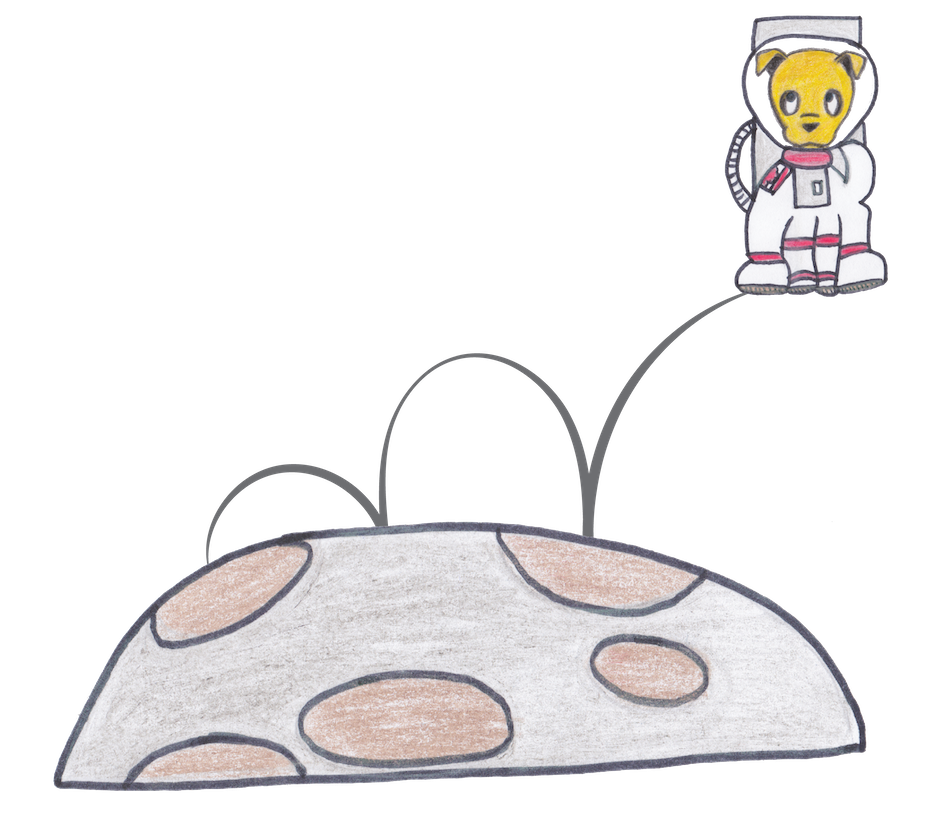
There is gravity anywhere there is mass! So yes, there’s gravity in space, which is what keeps the International Space Station and other satellites in orbit around the Earth, it’s just that in space, there’s no ground for our feet to press against, so we feel weightless. On the Moon, there is gravity, but the Moon is less massive than the Earth, so the force of gravity is also less on the Moon. Mars is also less massive than the Earth, but more massive than the Moon, so has more gravity than the Moon, but less than the Earth. That means that if you were walking on Mars, you would feel lighter than on the Earth (and would feel the force of gravity less), and you would feel even lighter on the Moon.
Why is space black?
Good question! There’s actually an old paradox that asks exactly this question called Olbers’ Paradox. The paradox is that if the Universe is infinite, and contains an infinite number of stars, why isn’t the sky completely glowing with the light from these stars, which should fill up the entire sky. The solution is that the universe had a beginning! There is probably an infinite number of stars in the Universe, but it takes time for light to travel and so there is light from some stars that hasn’t yet reached our eyes. In addition, because the Universe is expanding, the wavelength of the light from the very early universe has increased, which means that even if it once would have been visible with the naked eye, it has now moved out of the range of human sight.
What does it mean when they say the “vacuum of space”? Is it true there’s nothing in space?
There are lots of things in space, but they’re very far apart! The “vacuum of space” refers to the lack of particles and extremely low pressures in the space between celestial objects. That is, in outer space, there is almost nothing between the stars, planets, moons, and other solid bodies. For example, in interplanetary space, that is, the space between the planets in our solar system, there are only about 11 particles per cubic centimetre, compared to about 100,000 particles per cubic centimetre in the best vacuum that we can create on Earth.
Could we ever live on the Moon? On Mars? What about other planets or bodies in the solar system?
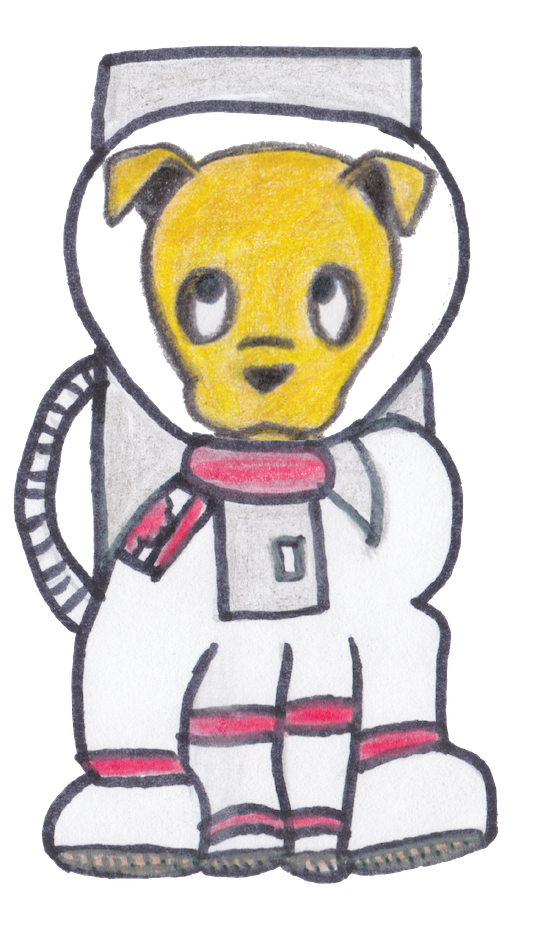
We could certainly live on the Moon or Mars if we created a base that contained air that we could breath. Unfortunately, the conditions in these places are very inhospitable to humans (and puppies)!
Some other planets and moons in our solar system may have life on them, especially some of the moons of Jupiter and Saturn, but they would not be able to support human life without some sort of self-contained base. The Earth is really the only perfect place that humans can live in the solar system.
Do you think there is life on other planets?
We’ve never discovered any life on other planets, but that doesn’t mean it’s not out there! There are hundreds of billions of stars in our own galaxy, and hundreds of billions of galaxies in the visible Universe. In our own galaxy, we estimate that there are more planets than there are stars, and that approximately 11 billion of these are Earth-like planets orbiting within the habitable zones of Sun-like stars. It seems extremely unlikely that our planet is the only place in the Universe where there is life. However, I also think that it would be very unlikely for us to run into other life in the Universe since the distances between the stars are so vast.
Is there air in space? Can you breath in space? How about on the moon?
There is definitely no air in space, which is why astronauts need to use spacesuits when outside of the Earth’s atmosphere or the protection of a spacecraft. The Earth’s atmosphere is this thin layer of air that is held to the Earth by its gravity, and is what allows us to breath while on the Earth’s surface. The Moon is not massive enough to hold air to its surface, and therefore it doesn’t have an atmosphere like the Earth does. That means that when you go visit the moon, you also have to wear a space suit because otherwise you wouldn’t be able to breath there!
Is it cold in space? On the Moon? On Mars?
Yes it is! This has to do with the fact that in order to feel heat, you need air or some sort of other medium for the heat to travel through. Temperature is basically a measure of how fast molecules are moving, so if you’re in a vacuum, you can’t very well measure that heat. On Earth, we feel the heat from the sun, even in the shade, because the air in our atmosphere stores the heat energy. However, in space, there’s no air, so this doesn’t happen. The moon doesn’t have any atmosphere, so the situation is the same there as it would be in the vacuum in space. Mars has a little bit of an atmosphere, which holds some heat, but its atmosphere is about 100 times thinner than it is on Earth. It’s also farther away from the Sun, so receives less of the Sun’s energy.
Our sincere thanks to Dr. Ilana MacDonald and LOOK:MATH! for this interview (and the images of the dog Alpha in space).